Thursday, February 16, 2012

Race Planning and LED's

Preparing and planning for the Rocky Raccoon 100 was pretty simple.  The course consists of five 20 mile loops that are pretty flat.  I planned to run a 15 minute pace per mile so the basic calculations were simple.  There are 5 aid stations per lap but two primary ones, the Start/Finish area at Dog Wood and Dam Nation.  Dog Wood is at mile 20 and Dam Nation is at mile 6.19 and 12.2 on each lap.  These two aid stations are the ones I planned to pay attention to.  The calculation for arrival time at each as is simple.  Runners first arrive at Dam Nation at mile 6.19.  Multiply 6.19 X 15 =92.85 minutes.  Divide the 92.85 by 60 =  1.5475 hours.  Convert the .5475 hour to minutes = approx. 33 minutes.  Therefore it will take me 1 hour, 33 minutes to reach Dam Nation for the first time.  I added 1 hour, 33 min to the 6:00 AM start and that gives you 7:33 arrival time.  Actually, I set up a spread sheet to calculate each aid station time which is printed below.


Next, I created the same chart for 14 minutes per mile and 16 minutes per mile.  If there had been a mountain between the start and the first Dam Nation, I would have had to guess how long it would take to hike up the hill, but that was not the case in this race.

The next step is to figure what you will need at the two drop bag aid stations, Dog Wood and Dam Nation.  Below is the chart I used to figure what I was going to need at each.


I used the 16 minute per mile pace for safety.  I figured I wouldn't be slower than that.  I used a one gallon zip-lock baggie for each of the 4 Dog Wood Stops (20,40,60 and 80 miles.)  I also used one gallon baggie for each two Dan Nation stops.  (One bag for 6.9 and12.2.  One bag for 26.9 and 32.2 and so on.)  Each of the baggies contained all the supplies I would need for that segment such as Vespas, NUUN tablets, 10oz. water bottles with Carbo-Pro, etc.  These baggies also contained critical items like flashlight, headlamps, hat and gloves for night.  I then put all four Dog Wood baggies ( labeled, 1,2,3, & 4) in one drop bag.  I put extra socks, shoes, shirts, etc in the second drop bag.  Runners were allowed two drop bags at each aid station.

This system worked pretty well for a couple of laps.  I did not take the time to pick up my drop bag at Dam Nation and sit down with it, so I started looking for what I needed and taking it out of what ever baggie I found first.  The problem with this was that by the last lap it was getting hard to find things.  If I run a race with laps like this again, I am going to organize drop bags differently.  I will try carrying a list of what I need at a particular aid station.  Actually, I knew exactly what I wanted at each aid station stop so I probably don't need a list at all.  Next I will put similar items in one baggie.  That is, I will put all the Vespas in one baggie, all the NUUN tablets in one baggie, etc.  When I arrived at the aid stations I knew what I wanted and it would have saved time.

A lot of runners at RR used small plastic bins with snap on tops.  I realized this would work great for a race where you are going through the same aid station over and over.  You just pull the lid off everything is visible and easy to keep in order.  And there is another plus, they are waterproof!  I am going to check to see if Cascade Crest allows plastic boxes as drop bags.  I don't think most 100 milers allow them.

I almost forgot about the LEDs.  Before each ultra I print out a check list for the race like the one below.  The first column (left) and top right items are things I gather days before the race, sometimes weeks before.  As I pull each of the item and lay them on a table I place a small check beside the item, not in the box to the right.  The box to the right is not checked until I actually place the item in my luggage or in a drop bag or in my hydration pak.  

I followed this chart (below) to the letter for Rocky Raccoon.  There were two minor problems however.  First, I thought my hand held flashlights used AAA batteries.  I had a lot of backup AAA batteries both in my hydration pak and in drop bags.  Trouble was, the flashlights use AA batteries.  Both back up flashlights went out within a hour of turning them on.  One in the morning and one that night.  No problem, they were backups.

Personal Items


Race Clothing


Billfold


Gaiters


Drivers License


Light Jacket – Keep in pack


Race Entry Registration


Running Shorts – 2


Credit Cads


Running Socks – 4


Money


Compression Socks


Lodging Info


Coolmax tops – 2 or 3


Alarm Clock


Fleece Top – Light


Light timer


Fleece Top –Heavy


Clothes to wear home


Fleece Pants


  Extra Shoes and Socks


Hot Chillies – top


  T Shirts


Hot Chillies – bottom


  Jacket


Tape -


  Coat -cold weather


Tape -


  Rain Jacket


Ankle Brace


Camera


Hats:


Sun Glasses


A. Cap


Sun Glasses Strap


B. Sun Cap


Reading glasses


C. Toboggan – Light


Towel


D. Toboggan – Warm


Paper Towels


Glover:


Extra Baggies


A. Light


Knife


B. Heavy-Warm


First Aid Kit


Rain Jacket


Extra Running Shoes


Rain Pants


Sun Screen


Tights – 2 Pair


Hydration Pak – 2 Lit


Extra Shoes


Hydration Pak – 3 Lit


Advil PM


Toe Nail Clippers


Day Before Race


Coarse Toe Nail File


Charge Camera


Sports Tape


Charge Phone


Ankle Brace-Old


Rest


Ankle Brace-New


Label Drop Bags


Add to Drop Bags


Clothing


Head Lamps


Extra Batteries


Sun Screen


Coolmax shirts – Light


Hats and Gloves – Cold


Tights


Ice chest


Jacket


Folding chair


Fleece or Hot Chilies


Towel


Hearing Aid Batteries


Blanket


Sun Glasses


Add to Back Pak


Extra Batteries


Flashlight


  A. Lithium – CR123A


Light Rain Jacket


  B. AAA Batteries – 6


Compass


  C AA Batteries – 2


Paper Towels


  D. Hearing Aid Batteries


Nathan Hydration Pack –3 Lt


Rain Pants


Nathan Hydration Pack –2 Lt


Money


Hand-held Water Bottles – 2


Extra Baggies


Extra Hand Held bottles – 2


Camera


Nathan 10oz bottles


Trekking Poles


Head Lamps – 2


Heart Pills


Flash Light – 2


Aspirin & Advil


Belt (waste) Light


Sports Tape


Stop Watch


Knife


Trekking Poles


Phone


Compass


Camera & Holder


Pace Chart


Sun Glasses & Strap


Course Maps & Info.


Drink Mix Powder in Bottles


Electrolyte Tablets/Pills


  A. NUUN Tablets


  B. Honey Stinger Waffles


  C. Enervit Tablets


  D. Thermalites


  E. PBJ mix & Bread


  F. Tums


Race Morning


Drop Bags


New Hearing Aid Battery


Sun Screen


Fill 2, 10 oz bottles – 


Paper Towels


Nip Bandages


Glide


Situate Run Number


Heart Pills


Gaiters


Aspirin


Hat, Gloves


Advil


Head Lamp


Tums


Belt Light


Mole Skin


Trim Toe Nails


Sports Tape


Apply Glide


Sun glasses


Arm Warmers


Arm Warmers


Road ID Bracelet


Ankle Brace


What I didn't know until I read about LED lights "after the race" is that they get much dimmer with time.  Both of my LED headlamps have been used for five 100 mile races.  Each has a lot of hours on them.  They were also stand-in lighting following several power losses at our house, including a tornado that missed our house by 200 yards in the April 2011 tornado outbreak that struck Tuscaloosa and Birmingham.  We had  no power for almost two weeks.  We have a generator, but it is not a whole-house generator so we just used it to power major items, like the "frig." and TV to keep up with the world. We used the headlamps at night.  

Both headlamps were pretty dim.  I could see but not very well.  I started depending on the hand held flashlight much more than usual.  I needed them to find my way around the worst of the mud puddles, some of which were several 100 yards long. That is, I depended on them for an hour.  After that, negotiating the mud became pretty hopeless.  I plan to amend the check list to note backup flashlight batteries are AA.


Monday, February 13, 2012

A Few New Ideas

First, I just found out that I got in the Cascade Crest 100 in Easton, Washington next August.  It looks like a spectacular course.  The trail passes about 30 miles northwest of Rainier so if the weather is cooperative we will have some spectacular views.  I had better start training for running in very wet conditions.  I was beginning to have a few problems at RR with wet and very muddy feet.  When I changed socks and shoes at mile 40. I had several "hot spots" developing that I think would have caused problems.  I have never had any kind of issue with my feet in an ultra.  The Cascade Crest 100 starts about 80 miles east southeast of Seattle so I am going to have to try some of those foot lubricants many people use.


I did a few things different at the Rocky Raccoon 100 and they all seem to work very well.  Well, one thing didn't work at all, but the rest was great.


To start with I ran in a new pair of shoes.  And I mean NEW!.  I ran in them 2 hours before the race.  I intended to start in them, but the weather was so bad at the start I decided to save them for later.  I put them on at mile 40, after the rain had completely quit and my feet were beginning to have a few problems as I mentioned in the first paragraph.  They are the pair of Brooks PureGrit trail shoes.  They were so comfortable when I put them on at the store I knew they would work, so I didn't worry about running in them.  I guess it helped that I had another, backup pair at the Dam Nation AS (6.2 and 12 miles out) and another pair back at Dog Wood at mile 60, just in case.  I did wear them on the plane flying out to Houston so they got a little more break-in walking around the airport.  Besides, they look cool!

I did make one potentially serious error regarding the shoes.  To save space in order to "carry-on" all of my critical supplies, I wore the Brooks out to Houston on the plane.  The Brooks were
a mess following the race.  Fortunately, I didn't wear my old pair of Inov8 in the race, so I had a
pair of shoes to wear around Sunday Night (I went to a Super Bowl party with my brother, Paschall and his wife Paula) and on the flight home, Monday.

Another change I made was switching from Perpetuem to Carbo-Pro for the race.  This was a real leap of faith since I received the Carbo-Pro about an hour before I had to leave for the airport.  (I have never used it before.)  I had filled all my bottles with another similar product already so I emptied them all and refilled all 24 with the Carbo-Pro.  Drinking Perpetuem causes me real problems.  I think it is the protein in the drink, but every time a took a drink of Perpetuem, I begin to feel like my stomach was about to explode, then I get the hick-ups, and they hurt.  This stuff has no protein and virtually no taste.  Over the course of 27 hours I drank 22 bottles of it.  I would have drank two more, but I forgot to fill my spare bottles twice leaving Dam Nation AS so I had none to drink.

The thing that did not work was my Peanut Butter and Jelly sandwiches.  Thursday afternoon in Houston I made 7 sandwiches, cut them in half and carefully wrapped each in plastic wrap.  During the race I ate exactly TWO!  There was so much good stuff at the aid stations, including egg and sausage and egg and ham wraps early, chicken noodle soup at all AS and potato soup at some stations, boiled potatoes and pizza. (I can't handle pizza after an ultra much less during one.)   They even had pecan and apple pie at one aid station.  I did eat some of each. They also had peanut butter and jelly sandwiches.  I didn't eat any of theirs PBJ either.  I threw the rest of my sandwiches away.  I just couldn't handle them.  I made a bunch of sandwiches for another race several years ago and did the same thing.  Somehow in a race they are not appetizing.  

So the Shoes worked great and the Carbo-Pro worked great.  The PBJ sandwiches did not work and my pace charts didn't work either.  Maybe I can figure out a way to get my pace charts to give me a shock every time I get ahead of pace!  There might be a market for that.

By the way, I have decided I was not bitten by a spider.  I think the problem is a strained Peroneus Longus muscle.  It is frequently injured by overuse or unusual activities you are not accustomed to, like running 40 miles in the mud!


To Fall or Not to Fall, That is the Question

The last two times I ran at Oak Mountain State Park, I stumbled.  Neither one by itself would have caused me to fall, yet the one three weeks ago landed me face first in the dirt with a skinned up chin and a sore nose, while the one this Saturday caused nothing more than a few accelerated steps off to the side of the trail.  Why would two almost identical stumbles end in such a dramatic difference?


I decided to talk a little about falling.  As the ultrarunning saying goes, it is not a matter of "if you will fall, but when you will fall."  I have fallen twice in one run and I have gone a year without falling.  (The year I went without falling was the year after I fell in mid October, struck my head on a rock and ended up with 24 stitches in my forehead.  That is an event you will remember.  I did not fall again until two weeks before Halloween, the following fall.  Exactly one year.  I guess that is why they call it FALL.  Do you suppose the leaves had anything to do with it!) You need to be prepared.  Actually, there are three types if falls.  The first is the stumble where you almost "catch" the fall but still end up on the ground.  The second is the fall where there was never any doubt, but you had time to get ready.  The third is "wham" with almost no warning.  


This third type fall happens so fast there is virtually no time to react.  You can try to get your hands out to ease the landing but that is about it.  This type fall happens when you catch a foot under a root or on a rock you didn't see and the foot comes to a stop and is, for all practical purposes,  locked in place.  There is little else to say about this type of fall except pay attention to the trail.


Before discussing the first two types of falls I will go over how one tries to avoid falling after stumbling, in the first place.  The trick, which you probably became very skilled at as a child, is very quick acceleration.  As you start to fall forward, spring forward while accelerating.  Sometimes it helps to take exaggerated steps. Sometimes this procedure will allow  you to literally "run back under" you center of gravity.  In some circumstances you may also be able to place a hand on the ground and push upward to help.  This works especially well going up hill.


There is a downside to accelerating and taking exaggerated steps however.  If  you do not catch the fall, when you do hit the ground you are going even faster therefore the collision with the ground will be even harder.  There is another potential problem with this sudden acceleration and especially the longer, "exaggerated" steps.  You are likely to have been running for a while at a very steady pace and the muscles become accustomed to a very constant range of movement and effort.  The sudden lunge puts a much higher force on the muscles in you legs, as does the longer step.  You can strain or even tear a muscle.  Some people go so far as to recommend not fighting a fall at all.  Personally, I don't like hitting the ground so I fight it where ever possible.


The first two types of falls (mentioned above) are different from the instantaneous fall.  As you stumble you actually have time to evaluate you situation.  The first thing to do is a quick evaluation as to whether you can avoid the fall in the first place.  If there is no chance to catch it, then my basic instinct is to roll to the left.  I have never rolled to the right.  I have no idea why, I just roll to the left.  The roll has a major advantage in that you decelerate rather than slamming into the ground.  If you are wearing a back pack it will add a little layer of protection.  If you fall straight froward there is a good chance you face will end up in the dirt or in a rock!


Here are the steps I go through when I stumble:
1.  Do a quick evaluation.  If there is a chance to avoid the fall, go for it, to a point.
2.  If you are going to fall, look where you are headed and pick out the best landing spot.
3.  Gets you hands out in front to control the landing and help you go into a roll.
4.  As you get up do a quick inventory to see if you lost anything when  you hit the ground.


That fourth step is important.  Frequently, when you fall, things fly off.  If you have on a hat, sunglasses, bottles in a belt, things in a pocket.  Check to see if everything is still in place.  Then search the ground around where you fell in case you forgot something.


Now, As to why I did a face plant on the fall three weeks ago and barely stumbled last weekend.  The first fall happened near the end of an easy final taper run before The Rocky Raccoon 100.  I stumbled slightly with my right foot which sent me off to the right of the trail.  I was headed straight for a small tree.  To catch the fall by lunging forward would have slammed my left shoulder into a 4" tree trunk.  That was not a good option.  I had room to fall to the right of the tree and roll but that would have probably placed my scapula in a direct line with the tree, or a least a few ribs.  The only safe option was to simply dive straight forward.  That is what I did but I was not able to keep my face out of the dirt and leaves.  It was a pretty hard landing.


This weeks stumble was an exact duplicate.  I stumbled with my right foot, launched of the trail to the right.  This time there was no tree in my path, just a limb I had to knock away from my face as I ran by.  I hoped back on the trail and kept going.


Of course, as mentioned earlier, the best way to avoid a fall is the to pay attention to the trail.  This will keep you safe most of the year.  In the fall and early winter, when the trail is covered in leaves, this may not even save you.  Use extra caution, especially when stepping into piles of leaves.  The lea side of rocks and along washouts in the trails require extra caution.  Be especially careful running down hill and stepping into piles of leaves.  Stepping down into a pile of leaves with your entire weight coming down on your ankle is a good way to twist and ankle or break something.


Thursday, February 9, 2012

Rocky Raccoon 100 - My pictures

I ran into Brian Hulbert, with Fleet Feet here in Birmingham, on Friday and a couple of other guys out to look at the course.  We all took pictures in front of the park sign at the entrance.


Below is the Dog Wood Aid Station and the Start/Finish line as it is being set up on Friday.

And a shot of the lake and lodge were Package Pick Up and the Pre Race Meeting was held.

 And here comes the winner of the 100 mile race.  Oops, that's the winner of the Kids One Mile. 

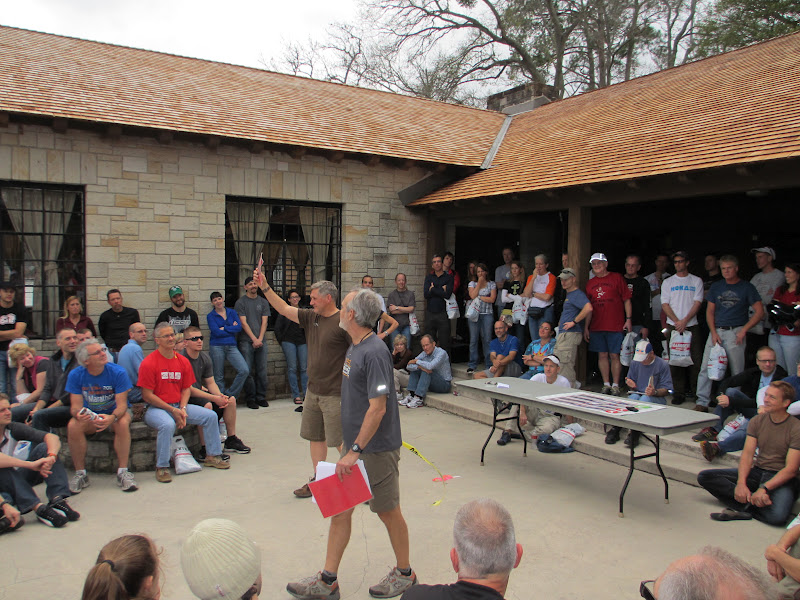
 Race Director Joe  Prusaiti, brown shirt, at the meeting and Henry Hobbs, I think, in the gray.

There was quite a crowd at the meeting.  The run actually crossed the dam, in the background at about 11 miles into each lap.

 Waiting for the start. 
  

Once the rain eased off I got the camera out.


Below is a shot of a section of Park Road heading for the Dam Nation aid station. 

Seems to be a little water on the lens.

Dam Nation and the Drop Bags.  (mile 6.2 and 12.2 of each lap)  This is the 6.2 side.

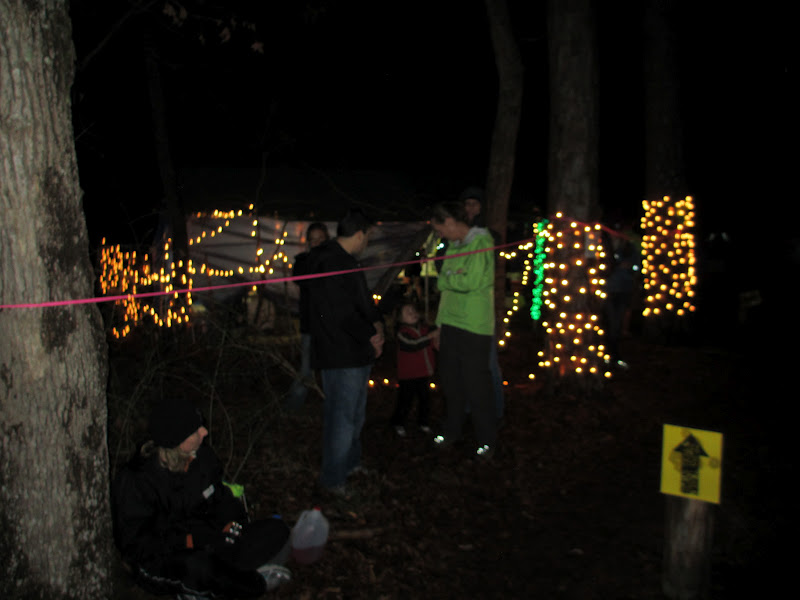
The Park Road Aid Station after dark at mile15.6 of each loop.

The Nature Center aid station,  3.1 miles into each loop.  This couple ran the aid station all night and they were always ready to help any way they could.

27 hours, 27 minutes and 04 seconds after the start.  Then I had to drive 80 miles back to Houston.  I knew I would have trouble staying awake so I solved that problem by eating.  I stopped at WhatABurger and got a double meat cheese burger, fries and a chocolate shake, and a large coffee.  Then I ate three Tums!

Next, I will go into a few new things I tried during the race that really worked well.


Wednesday, February 8, 2012

The Rocky Raccoon 100 or Hills Do Not Make The Race

After spending weeks worrying about what I decided was a tibial stress fracture, it  turned out to be nothing more than a bruise as I  at first thought.  My leg is fine and caused absolutely no trouble for the Rocky Raccoon 100.  The race was not without problems though.  Some I brought on myself, some, the result of weather and one slight issue, I can thank "mother nature" for.


I will start with weather since that was a rather serious issue even before the start.  Mid week, last week, the forecast for Saturday in Huntsville, TX, location of the Rocky Raccoon 100 on was for sunny skies and warm temperatures.  Then on Friday morning  the forecast was changed to a chance of thunderstorms early and showers later.  By Friday afternoon there was an 80% chance of thunderstorms early and rain most of the day and turning colder overnight.  By Saturday morning at 4:15 a.m. as I sat in the hotel room getting ready for the race I checked the weather channel.   Heading directly for Huntsville, Texas was a very long line of severe thunderstorms with a cold front behind.  I decided it was time to change a few plans.


I intended to start the race in my new Brooks PureGrit trail shoes but decided to start wearing my old Mountain Masochists instead.  The start/finish is located at the Dog Wood Pavilion and we would cross through there every 20 miles so that is the drop bag I put the Brooks into, along with clean, dry socks.
My new PureGrit shoes.  They are great.


As I sat in the car about 5:00 a.m. waiting for the start I was watching almost continuous lightning moving closer very rapidly from the west.  About 5:30 it hit.  It stormed so hard that I could not even hear the radio.  By 5:50a.m. about 10 minutes to the start of the RR, the severe line of storms was past but it was still raining very hard.  Four hundred runners tried to huddle under the tents that made up the core of the Dog Wood aid station, but there was just not enough room.  As the race started it was still raining hard but thankfully the lightning had moved away.  The rain continued to fall for much of the morning but I have no idea when it actually ended.  I dropped my heavy, hooded rain jacket at Dam Nation aid station at mile 6 on the first lap so it must have eased up quite a bit by then.  It did continue to rain lightly for a while after that.


The start.  Believe me, it was that bad.
Thanks to whoever took these pictures.  I think the one of the start was posted by Steve Holehan, but it was posted on the RR100 Face Book page by several people.  I had never encountered bad weather in any of my previous four 100 mile races.  This made up for lost ground.  The sections like the picture below were impossible to get around without getting you feet wet.  Runners trying to avoid the mess were creating trails out into the woods to avoid the mud but soon the bypass were just as bad.  


At least sections like below were not muddy and eventually the stream flowing down the middle of the trail drained and the surface was good.


The rain may have quit but the damage was done and the trails never recovered.  By the final lap, some of the muddy areas were beginning to improve but most were still ankle deep mud and water.

I made matters more difficult for myself by doing exactly what I planned not to do.  I starting out too fast.  Way too fast!  I ran the first 20 mile loop in 4 hours, 21 minutes, a pace of 13:04.  I ran the next 12.2 miles (of the second lap) at a 12:10 pace and finished the second lap at13:49.  I reached mile 52.2, the Dam Nation aid station in 11 hours, 50 minutes.  That means my 50 mile time  was about 11 hours, 20 minutes.  (That would be a 22 hour, 40 minute time for the 100 miles.)   I had intended to run a 15 minute pace which would have put me at mile 52 in 13 hours, 5 minutes and the 100 miles in 25 hours.  Of course I slowed way down on the final two laps and walked at least 15 of the last 20 miles.  Instead of finishing close to 25 hours I ended up running 27 hours, 27 minutes.

And then there was the issue of "Mother Nature."  At the end of the second lap I changed shoes and socks and removed my compression socks.  I noticed later in the day that the outside of my calf was sore.  The muscle felt like the fascia was constricting a muscle.  The discomfort continued the entire rest of the race but never got any worse and was only bad enough to be an irritation.

When I got back to my brother and sister-in-law's house in Houston and took a shower I noticed  the lower 2/3 of my right calf was red and very swollen.  I had no ankle, just a "stove pipe."  Apparently sometime after removing my compression socks, on one of my off-trail excursions around puddles, I made a spider (or some poisonous creature) really mad.  There appear to be two fang marks above my ankle.  What ever it was it never hurt except the soreness in my calf which may have nothing to do with the bite.  Both calves are sore but especially the right.  Anyway, it is better today.  My ankle is about half way back to it normal size and I intend to run about 6 miles this afternoon.  I think it will be a very slow run.  Hopefully a little faster than my last lap at RR.  I will post my pictures later.

By the way, there are actually hills in the RR.  There are mostly long gentle climbs, the type that are not steep enough to walk and too steep to run in a 100 miler.  The race does gain about 5,300 feet over the 100 miles.


Thursday, February 2, 2012

Ready for the Rocky Raccoon 100

I just wanted to post a quick note.  Over the last several months I used a "Train by Racing" approach to preparing for the Rack Raccoon 100.  Following the Lookout Mountain 50 Miler race one week before Christmas I ran a couple of easy recovery runs.  The first was on Dec. 24th, 2 hours, 41 minutes with 4 very hard hill repeats.  The second was on Dec 31 and was a 4 hour run at Oak Mountain with a bunch of hill repeats, but I didn't record how many.  Following that run I had a very sore spot on my shin that I assumed was a bruise caused by the top of the ankle brace I always run in on my left ankle.

There was a bit of swelling and it was pretty sore so I iced my leg most of the week to prepare for the only 8 hour run I had time to do in preparation for the RR100.  On January 7, I ran 8 hard hours at Veterans Park. The RR course is flat so I figured I needed to do my long run on a flat course.  At the end of the day my leg felt OK but a little sore.  I ran two hours the following day at Veterans and this time my leg HURT.  At the end of the two hours it was really swollen and I ended up walking with a limp.  That is when I decided I had a tibial stress fracture.  My shin was extremely sore to the touch in one spot on the front of my tibia.

I kept it iced or used a hot pack most of the next week and the swelling decreased.  On the 14th, what should have been a 5 to 6 hour taper run ended up being a 4 hour bike ride.  By the 21st, the swelling was about gone and I decided to try a 4 hour run on the flat "Lake Trail" at Oak Mountain and try out some new Brooks Trail Shoes I purchased from Fleet Feet here in Birmingham.  The shoes were great and my leg was fine.  No pain so I guess my first analysis was correct.  It was a bruise.  I ran another two hours Saturday with no problems except a minor crash that resulted in a scraped up chin.  I had an option of a "face in the dirt or a collision with a tree."  I took the dirt.

The final analysis is, I think the training by racing idea worked because I think I am really ready for the RR100. Making myself pace the entire race at a 15 minute per mile pace will be another story.  That is going to be tough in the early miles.